Pogonas – Bearded Dragon
This article will cover all the key parameters to create the complete habitat for your pogona.
It is important to remember that they are originally from the deserts of Australia and as such, require a lot of light (full spectrum UVA/UVB), heat (one light basking light), and low humidity.
Since our climate has nothing to do with it, we need to use a conditioned and adapted terrarium to recreate its habitat, we begin:

What terrarium does my pogona need?
They reach a size of approximately 45-50cm and after one year they can reach 30cm, therefore we must assess whether we are going to buy a definitive terrarium or if we are going to acquire a temporary one in case we buy another specimen.
The size of the terrarium should be chosen based on the following factors:
- Number of specimens: Males are very territorial, having two specimens can be a problem if we do not have a large enough terrarium.
-
Male/female relationship: If you decide to have more than one pogona, you must opt for:
- 2 females
- 1 female and 1 male in separate terrariums, at least during the breeding season.
- 1 male and 2 females or more together
This is due to the great territoriality that the males have, especially in the breeding season, they are aggressive.

They do not require an excessively high terrarium, the surface is more important than the height , but it is good to have some height to be able to put a branch, trunk or rock through which you can climb a bit and get closer to the bulb and thus increase its temperature . We also need to be able to install the bulbs and have them be at the proper distance.
You can opt for smaller dimensions for the first years of life : 75x40x40 or 100x40x40 are a very good option. They are our small standard measurements, they are available to ship and you receive it tomorrow.
But you can also directly purchase the final terrarium, for an adult specimen a suitable measurement would be 100x50x50 although it is much better to opt for 120x60x50, these measurements are also standard.
If you are going to buy a group of pogonas, for example a group of 1 male and 2-3 females, the appropriate size would be 200x50x50 (also standard) .
Here you can see our 200x50x50 terrarium:
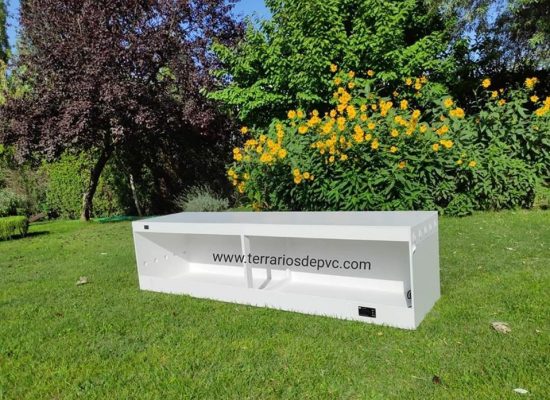
The best terrariums for pogonas are PVC ones:
- Thermal insulation: energy saving.
- Very low weight compared to wood and glass.
- Easy internal cleaning.
Negative aspects of other terrariums:
- Glass: They do not maintain heat properly, this means that the heat bulb has to be on for much longer with the expense that it entails. Another fundamental factor is stress, allowing you to see beyond your terrarium will cause you stress by avoiding going out continuously. They are too heavy.
- Wood: They retain heat somewhat worse than pvc. They weigh a lot and hold very little moisture and water, which can be a problem if the drinker tips over.
What lighting does a pogona need?
It is important to install a good UV light bulb in the terrarium, both in light level and full spectrum UVA/UVB.
UVB radiation is necessary for bearded dragons as it influences the digestion of food.

How long do I keep daylight in the terrarium?
Approximately 12-14 hours of continuous light . This is easy to control thanks to the timers that exist on the market today, we can set the exact hours and minutes in which it will turn on. They are very cheap. You can see more information about them and about how to automate the terrarium here: Timer.
What UVB bulb do pogonas need?
We can find manufacturers that under the same bulb offer different UVB factors , desert species are the ones that need a higher factor. These factors are also called UVB indices.
Currently , the best quality UVB bulbs on the market , which really offer the radiation they indicate at the distance they indicate, are HID bulbs (metal halide) and mercury vapor (no ballast needed), it is true that they are more expensive and that HIDs need a device called an electronic ballast without which they cannot work, but they are of the highest quality and have a slightly longer useful life .
Both HID and Mercury Vapor are also heat sources, all-in-one bulb.
The best UVB bulb are these:
It will be convenient to analyze the height to the substrate because in some models the distance at which the animal receives the radiation is minimal and we may not be providing them with sufficient UVB-UVA radiation.
All UVB sources expire , so they must be replaced once the useful life indicated by the manufacturer has expired, HID and mercury vapor have a longer useful life. Although it continues to emit light, when the useful life specified by the manufacturer is over, they stop emitting UVB rays, so you must be careful to change it regularly.
Letting sunlight through the windows does not work, the crystals block radiation. These bulbs usually have an expiration date, which varies depending on the brand or model.
It is also very important to know the distance to place the bulb with respect to the substrate, the manufacturer also indicates the ranges in which they are no longer effective. Too short a distance will cause thermal burns and going too far will logically decrease the radiation factor.
In the following photo we can see how the radiation varies depending on the distance at which it is placed from the substrate:

What temperature does a pogona need?
As with any reptile, it is necessary for your terrarium to have a heat source, which provides the temperature it needs. As with light, we must simulate the cycle of the sun, that is, we will maintain high temperatures during the day of 35 to 40ºC in the hot spot and a lower temperature at night, approximately 18-22ºC.
The heat source that we must install is a heat bulb , to know the temperature of our terrarium we will need a thermometer like the one that we include in our terrariums.
Pogonas are ectothermic animals, cold-blooded, so it is necessary to provide them with a source of heat . The size of the terrarium must be large enough to be able to establish the hot spot at one end and the cold spot at the opposite, that is, have a thermal gradient that decreases towards the other end, where the turtle will surely choose to sleep. , as it will identify the cold and warm areas of the terrarium.
- The hot spot is the part of the terrarium where the heat bulb will be placed.
- The cold spot is the opposite extreme to the hot spot, this is achieved naturally with the size of the terrarium and ventilation.
In the hot spot we must achieve the maximum adequate temperature , during the day from 35 to 40ºC .

At night we must maintain a lower temperature, the one we have commented of 20-22ºC. It is usually enough to turn off the heat source. But in cold houses or at times of the year where the cold outside influences the terrarium too much, it will be convenient to keep a heat source on to keep us at the right temperature. We will have to play with the different devices on the market to automate the terrarium. In this article I show you how to: Automate terrarium
You can purchase our thermostat that automates everything and install it in your terrarium without any difficulty: click here.
Sometimes, when the daytime temperature of the room allows it, we may not have any heat source on, but if we require it, there are thermostats with a day/night option that will control the heat source according to what we program, thus getting rid of problems and headaches, you can see this type of thermostat by clicking here.
If, due to the environmental conditions of the room where the terrarium is, it is necessary to turn on the heat at night, the ideal is to opt for ceramic or infrared bulbs so as not to disturb the turtles with light. ( Types of heat sources ).
What power do I buy the bulb?
There are different types of heat bulbs : ceramic, infrared, spot, HID or mercury vapor. In each of these types of bulb we find a variety of powers that sometimes surprises, 25-50-75-100-150-200-250w….. in other brands 35-50-70w.
Remember that HID and mercury vapor also provide UVB/UVA lighting.

Well, there is no universal power, depending on the manufacturer they will give certain temperatures, you have to play with the size of the terrarium and the orientation of the bulb to obtain our desired temperature .
In the following photo we can see how the temperature achieved varies depending on the distance at which it is placed from the substrate:
A trick to not fail is to take a higher power and connect it to a thermostat, so the problem is solved because the temperature that we will have will be what we want, the one programmed in the thermostat.
The second is a very very simple thermostat, it keeps the temperature at the exact value you tell it, it does not require difficult connections or installations, you connect it, set the temperature and it works, in 20 seconds and at a very competitive price (European connections, it works for Spain plugs).
The third is the most economical temperature controller thermostat with a day-night function, that is, we can tell it to maintain certain temperatures during the day and others at night. It also has a timer function.
What humidity does a pogona need?
A fundamental aspect to keep a bearded dragon is to keep the humidity low, around 30-40% .
How do I lower the humidity of my terrarium?
Well, not only one factor intervenes , we have to play with the ventilation of our terrarium, the position of the drinker and the heat source, the substrate... everything influences.
We can lower the humidity in the terrarium with good ventilation of the interior air, placing the drinker away from the heat source or choosing a substrate that retains little humidity.

What substrate does my pogona need?
There are substrates on the market that are not only beautiful and realistic , but are suitable and perfectly simulate the deserts of their habitat.
The substrate they need depends on whether they are adults or small:
- Small: It is advisable to use newspaper or kitchen paper, since the youngest dragons will have to eat more insects than the adult dragons. You have to be more careful with them with the ground because the chances are high that they eat sand or dust and it will cause obstructions and they may end up dying, but the truth is that in their habitat they move through sand and stones.
One of the simplest options as a substrate is the Exo Terra Sand Mat , a ground mat that prevents them from swallowing anything, prevents obstructions, very realistic, very hygienic and easy to change.

- Adults:
In substrates for adults, whoever you ask will tell you one thing, after having kept pogonas and reading many opinions on forums, the best or most used substrates for adults by far are:
-Coconut fiber: Widely used since it does not cause obstructions. See coconut fiber: here.
-Crushed corn
-Wheat bran
-Sand shells: very cheap and used

But we also find ourselves in the market with:
- Exoterra Sland Mat.
- Calcium sand: This is a substrate created specifically for pogonas, if they swallow it, it ends up dissolving and prevents obstructions.
- Other valid litters: With them it is advisable to use a feeder to feed it, we recommend one below.

Example red sand together with Zoomed's Excavator substrate :

What does a pogon eat ?
MEAL:
[amazon bestseller="Pogonas food" items="4" template="table"]
WATER:
decoration for pogona
Important!! As we usually decorate terrariums with elements that allow the animal to climb and get closer to the bulbs, I recommend installing a protection cage .
- Cave: Necessary for your animal to take refuge at night to sleep and to reduce stress. There are numerous models, the most practical are those that allow access without dismantling all the decoration. Here is a series of very realistic caves:
- Hammock: We have esparto hammocks made specifically to decorate terrariums. We have 3 sizes available that you can buy NOW to install it in your terrarium. Here I show you the terrarium of a client of ours in one of the hammocks:
- Rocks and logs: Very useful so that the pogona can climb up and get a little closer to the bulb, so it will be she who can increase or decrease her body temperature and thermoregulate. They will make it better adapt to its new home and will facilitate more natural behaviors, which will be a good sign of the state of health.

- Branches and plants: Like the rocks, trunks and caves will help make the habitat of our pogona more realistic. The ideal would be to plant natural plants that can live in the temperature and humidity conditions of our pogona, but we can always opt for artificial ones. We have both branches/vines and strips of leaves, you can find them in our section: ACCESSORIES
phases and types
The most common pogona phases (coloring) are: Nominal, Snow, Silback, Red, German Giant, Blood, Hypomelanistic, Gold, Leatherback, or Leucistic.
The most common types of pogona are: Pogona Vitticeps, Pogona Henrylawsoni, Pogona Barbata, Pogona Nullarbor, Pogona Mitcheli, Pogona Minor
